
27.08.2026
High End Technology
We develop extraordinary camera systems for highly demanding defence, police and security, industrial and medical customers that require a solution.
Understanding Color CMOS
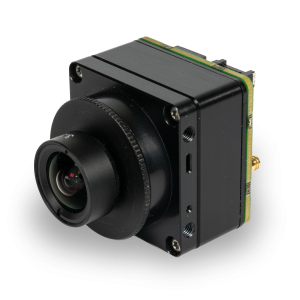
This is the most accurate representation of any scene as the sensor operates in the same spectral domain as the human eye. The sensor operates in the “visible” part of the spectrum shown above. Our cameras are compact, offer full-HD resolution and are very sensitive. Advanced image processing makes the best possible image even when there is very little light. A CMOS sensor in it itself is not sensitive to color, it needs filters to pass light of a certain color. The camera then calculates the proper color representation from the filtered information. The filters are arranged in a “Bayer” pattern, as shown below. Our cameras that meet these requirements are the Crystal 42 Nova, the Crystal 30 SBC and the Crystal 35 Spark.
Each pixel in the CMOS has a filter. A cluster of 4 pixels (2 x 2) in the BG-GR sequence (2 x 2 square) is used to calculate the color of one single pixel. This process is called de-bayering and is performed by the camera hardware. These filters are not perfect. They will filter out the required colors, but they are transparent to near infrared (NIR) light. And the CMOS pixels are sensitive in that region of the spectrum and pick up the NIR photons as signal. This is why a NIR filter in front of the sensor is needed for an accurate color representation. It is called a NIR cut-off filter, and it is often fixed in front of the sensor. In some cases, a coating in the lens performs as a NIR cur-off filter. In security cameras that can also work at night the NIR cut-off filter is often removable. Then the camera switches to black/white operation. This is often called “night-vision” mode.
It is important to note that due to the absence of white light at night, an accurate color representation is impossible. Whenever there is some white light from artificial light sources then it works. Otherwise, most of the light during the night comes from NIR or SWIR sources. Very sensitive cameras may be able to use white light from stars to produce a color image at night, but these are very rare and color representation is not accurate. All ITS cameras are calibrated for accurate color representation.
A disadvantage of color cameras is that, since each pixel is composed out of its surrounding brightness values, the ability of showing fine details is limited. In addition, since the human eye is more sensitive to brightness than to color definition, a color video signal has a brightness value for each pixel and only one color for 2 pixels. This is called 4:2:2 sequencing and is the case for all HD-SDI and PAL/NTSC cameras. Only CameraLink gives accurate 24-bit color information for each pixel.